Recently, I heard Jeremy Courtney, President and Founder of Preemptive Love interviewed. He and his family founded an international relief organization which engages with people located on the front lines of the world's most polarizing conflicts in Iraq and Syria. (https://preemptivelove.org/jeremy-courtney/)
To put it practically, he and his family decided to move to these places to literally serve as the hands and feet of the church. Curious to how such an idea started, the interviewee asked Jeremy to share how the journey began...because it is not every day a family decides to pick up, move across the world, and plant themselves in a literal war zone.
Jeremy talked about how the stirrings to do what they are now doing all started back the night of 9/11. After our world here in the US was completely rocked by the terrorist attacks, he and his wife, like many of us that day, didn't know what to do. Do we fight? Do we cry? Do we grieve? How are we to respond in the midst of devastating chaos?
His community that night decided to move in a different direction. They decided to rally together to pray, but not just pray for our mourning country, but pray for Osama bin Laden himself. That somehow, and in someway, God would move over his life; that God would move mightily in this part of the world; that grace instead of terror would be embraced and that love instead of darkness would prevail. They fought to remember that Osama bin Laden was a person too. Evil, yes. But could God still do a mighty work in his life? They fought to not label that region of the world that night. They fought to not write the enemy off. They fought to believe God would and could be seen in and through all of it.
In the interview, Jeremy quickly got down to business. How do you impact darkness? How do you bring light into places of literal terror? How do you stop seeing the enemy as the enemy and start seeing them as a person?
In his words, "You particularize."
You take that big, huge, outrageously out of your league problem, and you break it down, and then you take the next step...and then the next...and then the next. But more than anything, the heartbeat of each step has to be moving towards a person and not the problem. Because if all you see is the problem, you will forget the person. You will forget that the person behind "enemy" lines is actually more like you than you could ever imagine. They are hurting. They are scared. They are someone's son. They are someone's daughter.
You have to figure out how to love first, and ask questions later. You realize the costs, and then you love anyway.
Jeremy's interview reminded be about the power of narrative. It reminded me of my own hesitations to get involved in causes near and dear to my heart because quite frankly they just seem too overwhelming. Too much complicated policy. To many politics. Too many options to vet and figure out is this an organization stewarding their resources correctly--is this a place that has the same heart beat and vision that I think I am being called to?
So what do I do, nothing. I do nothing because I am totally overwhelmed.
I've been reading in Acts recently. Acts is the chapter in the bible that is all about spreading the news of Jesus/aka the building of the church. At that time, Jesus had died, and returned to heaven, so the "building" was being done by His followers. They were the ones in charge of going to all the places, to spread the message of the gospel. One would think the most effective way to have the most amount of impact on cities and people would be to pray for God to provide platform opportunities where the disciples could speak to the masses. In order to have the quickest growth, you need rallies and conferences, and massive meeting places. And there were times when God did provide these types of gatherings. But more often than not, the gospel message was spread through one on one encounters and small, intimate gatherings of people.
On a couple of occasions, both Paul and Peter are recorded going out of their way to stop, engage, and see those who were more often than not invisible to the average passerby. It was common for the disabled, impoverished, and hurting to be outside the temple entrance to beg. In Acts chapter 3 and 14, such scenes are described. But instead of doing what everyone else was doing, something stopped both Peter and Paul on different occasions.
Something tugged on their heart as they passed the individuals. They heard the beggars words, but instead of just passing them a few coins, and paying them no further attention, the text says they looked them in the eyes.
It is important to note, that both of the men that were begging that day were crippled. They could not walk, they could not stand. They had to be carried to that location or perhaps somedays they literally crawled. No one looked them in the eye; people either ignored them or looked down on them as they passed them by.
But on those separate days, both Paul and Peter had to of heard that whisper in their heart as they passed these men by: Go look them in the eye. Don't look past them. Don't write them off as poor, crippled, beggars just looking for handouts. Get on their level. Adjust your posture. Bend down, and look at my child right in the eye.
The Message version of one of these accounts says, "...And Paul, looking him in the eye, saw that he was ripe for God's work, ready to believe." Acts 14:8-10
I have done a lot of labeling in my life. I have put labels on people that were so wrong, so hurtful, so cruel. Addict, liar, cheat, manipulator. Labeling made me feel safe. It let me put people in boxes with closed lids, and then I got to put them in that basement closet, where I would turn off the lights, lock the door, and throw away the key on my way out.
Ultimately, I stopped seeing the person, just the problem, and I learned to walk on by, paying those hurting around me no attention.
When I read those two accounts in Acts about Peter and Paul, I heard that same whisper they likely did that day.
This is what I have been trying to show you. I want you to look at my people. Get on their level. Bend down, change your posture, look them in the eye and really see them. See that they have a story. See that they have a narrative over their life. See they are hurting...but more than anything see that they are ripe for my working. They are ready to believe. But you have got to start seeing them.
For a long time I have labeled my mom as an addict. And by the world's definition, she is that. But over this past year, I have had to find that key to that basement closet, pull down that box, and take off the lid. I have had to learn to remove that overused label.
Because the thing is, my mom is so much more than that label. She is one of the most beautiful, strong, kind, and caring people that I know. She is my mom. She birthed me, she raised me, she took all the goodness she knew how to give and she gave it to me.
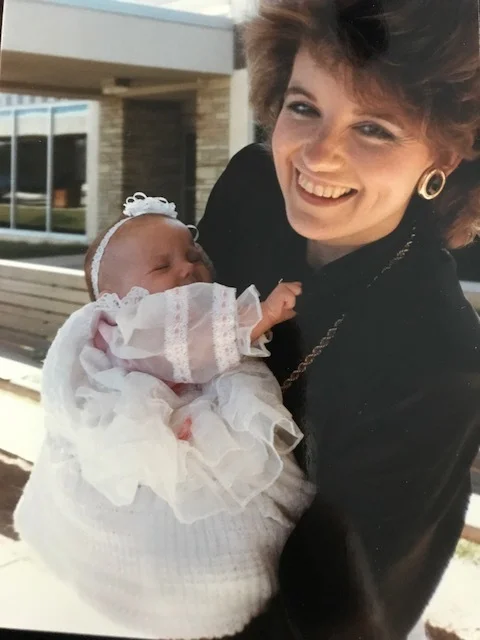
But I forgot all these things. All I saw was the problem. All I saw was the label.
There's an addiction epidemic sweeping across our country. No one really wants to talk about it. Because how do you solve it? It is too big, too complicated, too hard. When you are in it, all you can think about is how in the world are you going to hold on?
So we label. They are a "this" addict. They are a "that" addict. We stop forgetting that these precious people are sons, daughters, wives, mothers, fathers, sisters, and brothers. We forget their names and just remember their labels.
Addiction does not start over night. It is complicated. And the statistics will tell you there is always, always a story behind the problem. A story soaked in pain. A narrative that will leave you realizing it just as easily could have been you instead of them.
So how do we stop the labeling?
We particularize.
We fight to see the person, first. We turn back around, we take off that label lid, we look them in the eye, and we ask: How am I to love you anyway? How am I to show you that I see you? How am I to tell you God sees you? How do I stop spewing labels, and instead respond with: But first, she is my mom. But first, he is my dad. But first, they are my child. But first, he is my brother. But first, he or she is a person, wholly and dearly loved just as they are...no labels.
